Johann Jacob Brumbaugh (1726-1799) From Original Research
Johann Jakob Brombach (1726-1799) was born February 8, 1726, in Osthelden, Siegen-Wittgenstein, North Rhine-Westphalia, Germany, the son of Jakob Brombach (1690-1738) and Anna Catharina Siebel (m. 1720), and he was baptized at Kreis Ferndorf. He died April 10, 1799, in Bedford County, Pennsylvania. His body was carried back to his home farm, Claylands Contrivance Resurveyed, north of Hagerstown, Washington County, Maryland, where he is buried in a family cemetery off route 10, where a black, wrought-iron fence protects his headstone in the middle of a cornfield. (The cornfield is owned by the Hagerstown Regional Airport and they are legally required by contract to continue to maintain the gated cemetery). In his new home, he became known as Jacob Brumbaugh, with various spellings used.
Jacob arrived at age 24 in Philadelphia on Capt. Thomas Coatam’s ship Nancy on Aug. 31, 1750, from Rotterdam via Cowes (an island in the English Channel). Family legend recorded is that he arrived with 50 pounds sterling in his pocket (which was a goodly sum, the equivalent of two years’ pay for a British soldier then). Prayer coventicles were prohibited in his homeland, and it is likely that he emigrated both for greater religious freedom as well as economic opportunity. He signed his name to take the oath of allegiance to the British king and to the colony established a century earlier by William Penn. From there, he sought inexpensive but fertile farmland and found it in then in Frederick County, Maryland, where, described as a “weaver,” he bought 50 acres in 1753, the beginning of his eventual 900-acre farm property. There he grew wheat, rye, barley, oats and other grains. Local records show that Jacob owned no slaves and grain farmers did not generally need them like tobacco farmers did.
Part of his farm lay on the line which Mason & Dixon laid out in 1765 as the agreed-upon corrected boundary between the colonies of Pennsylvania and Maryland, which before 1765 had been in dispute.
Jacob married Mary Elizabeth Angle/Engel (b. c. 1740 of Henry Angle, dates unknown, an earlier German immigrant) who is recorded by some church historians as “the first convert to the German Baptist Brethren sect in western Maryland”; this marriage occurred sometime in the late 1750s when it is likely that settlers had to fall back East a few miles to avoid widespread Indian depredations during the French & Indian War. During that war, family legend, recorded later, notes that Jacob served as a “packman” on the Braddock Campaign of 1754 which marched close by his farm; and local records show that Jacob “quartered” soldiers on his farm and served as a “scout” for Jonathan Hager’s rangers during those years. (There are also multiple stories recorded in early 20th c. Brethren histories of Jacob Brumbaugh aiding Col. George Washington during that Campaign, but without any recorded evidence to support them. Evidence does reveal that Washington was injured at the same time as his batman was also injured and that Washington paid someone unnamed for a week’s nursing and that later Washington in correspondence acknowledged that Dunkers were especially proficient at healing arts.)
Jacob’s farm prospered and he and Elizabeth had at least seven children, all of whom survived to adulthood, married, and six of whom had their own children: Jacob Jr. (b.c. 1760) m. Catherine Rentch; Mary Elizabeth (c 1761) m. Samuel Ullery (a Dunker minister); John (c 1762) (also a Dunker minister) m. Mary Elizabeth Miller; Daniel (1772) m. Elizabeth Long; David Angle (1776) m. Anna Eve Kiessecker; Henry (1777) m. Margaret Rentch; and George (1783) m. Louisa Gelwicks (childless until they adopted a baby girl).
Around 1763 the local town Jonathan Hager had named after his late wife, Elizabeth town, was formally recognized. It prospered and was only later in the early nineteenth century that the town became known as Hagerstown.
Johann Jacob was over 50 years old in May 1776 at the time of the revolutionary war and the draft age was 16-50 then in Maryland, so he was exempt on account of his age. He gave over his “gun” as he was instructed, to Capt. Cellars. When blankets were collected for the army, he gave 2 blankets—these actions are recorded in the minutes for 1776 of the committee of observation of Elizabeth town; and later in the war, he sold grains to Henry Schnebely, the local agent for the Continental Army as is shown in a receipt of 1780. All these actions were later in about 1912 deemed by Daughters of the American Revolution (as well as the Sons of ….SAR) as actions qualifying Jacob as a “Patriot”; therefore, his descendants can qualify for membership in these organizations. As Jacob was a member or supportive of the Church of the Brethren (then called “Dunkers”), which was devoutly pacifist, we have the rare, but not unheard-of, occurrence of a pacifist as patriot. His sons Jacob Jr. and John both paid fines in Dec. 1776 indicating that they were both then of military age and pacifist Dunkers.
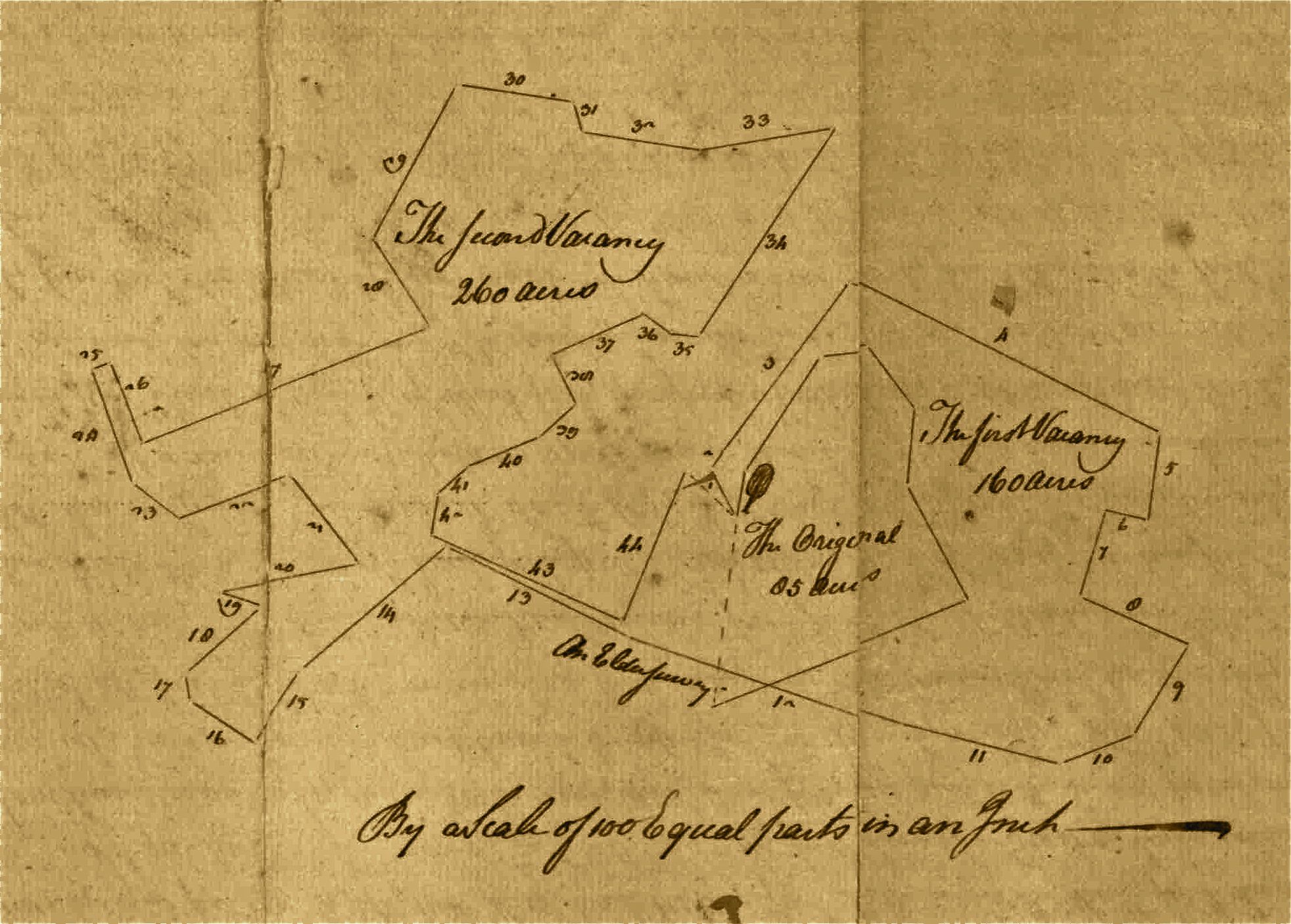
Jacob’s and two his eldest sons’ non-participation in the revolutionary war never seemed to have unduly disadvantaged the Brumbaughs as it did many pacifists who were fined, publicly shamed, punished, ignored commercially, had their livestock and furniture distrained to pay fines and otherwise severely disadvantaged. This did not occur to Jacob, and he and his family prospered in the post-war period. They prospered so much that Jacob seemed to have a mission in the 1780s & ‘90s to buy up as much farmland as he could in a pacifists’ paradise called “Morrison’s Cove,” a fertile valley in Bedford County, Pennsylvania, about 80 miles northwest of Hagerstown where other Dunkers and Mennonites lived. He bought there 12 farms of aggregate acreage of about 3,000 acres. Land speculation was then rampant. It is likely that Jacob was thinking ahead to his children’s inheritance and determined to see that they had farmland enough on which to make a living. Today, there is in the Cove a Brumbaugh Mountain and a main road called Brumbaugh Road. (Numerous members of both lines of Brumbaughs discussed in this sketch lived at some point in the Cove).
Three of the farms so purchased were bought from Henry and Elizabeth Drinker, an elite, wealthy Quaker merchant couple in Philadelphia. There is correspondence between Jacob and Henry in Henry Drinker’s archives at the Historical Society of Pennsylvania in Philadelphia. Also, in 1803 Jacob Jr. traveled to Philadelphia to pay off the final balance of a mortgage on one of the properties, and on Aug. 23, 1803 he was invited in to breakfast with the Drinkers (as recorded in page 1677 of volume 3 of Elizabeth Drinker’s nearly 50-year diary published by Northeastern University Press in 1991) to complete that transaction. Drinker had a leaning toward selling to German pacifists on the belief that they worked hard and were better credit risks.
The other action Jacob Brumbaugh took in the post-war period was to operate two copper stills for distilling grains into whiskey. Jacob was a fairly major distiller when he died with over 450 gallons of whiskey in the inventory of his estate. When the administrators of the state held the public auction a couple months later, they sold only 270 gallons, leaving 80 gallons to be consumed at the auction by the 75 people who attended the 2-day affair. No doubt, a good time was had by all. Although Brethren congregations often admonished their members not to drink alcohol to excess, particularly at estate auctions, many did so anyway. Among the inventory items were “a Table and 16 benches” “up Stairs” in the barn. This is usually regarded as an indication that he held “home Church” on the second floor as Dunkers often did. There were no guns or muskets among the inventory, another indication of pacifism. There were “12 old books” indicating some level of literacy. The son Jacob Jr., however, indicated in his correspondence with a creditor that he had had the local schoolmaster write the letter, so the level of literacy was likely not too high in the earliest Brumbaughs. There were also no slaves recorded as part of the inventory; Brethren admonished their congregation not to own slaves.
Philadelphia Quaker merchant Henry Drinker described Jacob in a letter to a correspondent in Maryland as “a bearded German,” the only physical description ever found of Jacob, and many bearded Germans then were sectarians like Jacob.
If one of Jacob Brumbaugh’s goals in emigrating to America had been to work hard to achieve the most he could achieve in an agricultural environment, he had succeeded. If one of his goals was to found a large family on a firm footing with ample land and wealth to provide a sure financial base for his offspring, he had also succeeded at that. One of the goals of Brethren folk was to turn out ample population for the local congregation of the Brethren church. In this effort Jacob had partial success as his eldest three children, Jacob Jr. married to a Dunker, Mary Elizabeth (the only daughter) married a Dunker minister, and John also served as a Dunker minister, were ready to keep the modest numbers of the faith thriving, though his other children affiliated themselves with other churches, in the mainstream of Protestant denominations, mostly determined by the faith of their wives.
Jacob died intestate meaning without a will. His eldest son, Jacob Jr. and his wife served as co-administrators. They had a Maryland and a Pennsylvania estate to settle. The estate settlement was completed amicably over about five years. We have a copy of the inventory of tangible personal property in Maryland and it contains no enslaved individuals, no firearms, lots of whiskey and a broad assortment of farm implements and whiskey distilling equipment. A public auction was held in June 1799 at which all these items were disposed of. The land tracts were distributed equitably among the seven children and Henry got the family farm which he worked until 1754 when he sold it. The total estate exceeded in value $12,000 which made him a relatively wealthy farmer and immigrant. His wife died in 1806.
This pacifist had been an immigrant, a Patriot in his adopted country, a husband and father and grandfather, a Dunker, a farmer and distiller, and a success at nearly all his endeavors. When he died in Morrison’s Cove, Bedford County, Pennsylvania in April 1799, his family carried the body back to his home farm, Claylands Contrivance Resurveyed in Elizabeth Hundred, Washington County (the first, in September 1776, of nearly sixty counties and cities to be named after our first president), Maryland [FindaGrave memorial # FaG 158346036]. Washington himself died in December of that year and he too had been a grain farmer and, in his last few years, an even larger distiller of whiskey than Brumbaugh.
Jacob Brumbaugh’s home, built in the 1750s, was long the #1 “most endangered historical property” in Maryland according to the Maryland Historic Trust, but the property on which it sits has been owned by the Airport for several decades and the old building was recently torn down by the Airport. Some artefacts may be housed at the Maryland Historic Trust. The house was listed “for its connection with the early settlement of Washington County.” Maryland Historical Trust Inventory (WA-I-480).
Note Bene: There were at least 5 Jacob Brumbaughs during this Jacob’s time and even more came later. Untangling them is sometimes a chore and leads people astray in assuming the person they are researching is one Jacob and not another. First, this Jacob (1726-1799). He had, second, his son, Jacob Jr. (1760-1814)[FaG 211261461] [(FaG = Find-a-Grave.com Memorial #]. Third was Jacob called “Jockel” Brumbaugh (1734-1816)[FaG 158674715], a son of Johannes Henrich Brumbaugh, about whom little factual detail is known. Jockel had a fourth Jacob, his son Johann Jacob Brumbaugh Kemper (1764-1848)[FaG 38598071] and siblings Georg called “Yarrick”, Conrad, and John (also known as Johannes der Strumpf Weber = “John the stocking weaver”). Each sibling had a large family of 8-15 children and many repeated the names Jacob, John, George, etc. in ensuing generations including a fifth Jacob, Georg’s son Jacob C. Brumbaugh (1797-1871)[FaG 12311831]. We believe that Johannes Henrich Brumbaugh was either a brother or a cousin of Jacob Brumbagh-1, but definite documentary proof is hard to come by. Evidence has recently surfaced to indicate that Johannes Heinrich was born 2 miles from Osthelden where Jacob was born.
Martin Grove Brumbaugh, Ph.D. (1862-1930), an educator of renown and governor of Pennsylvania, as well as a Brethren bishop, and Gaius Marcus Brumbaugh (1862-1952), a physician and esteemed genealogist who wrote the book on Genealogy of the Brumbaugh Families in America, were descended from Johannes Henrich Brumbaugh (no known dates), a contemporary of Jacob’s in the same area. Both men served with distinction long terms as board members and MGB as president of Juniata College.
(Sources: Gaius Marcus Brumbaugh, Genealogy of the Brumbaugh Families in America (1913) which was unable to determine Jacob’s birthplace but generously reproduced deeds and much other primary source material; Report on Johann Jacob Brumbaugh by Anne Augspurger Schmidt-Lange, certified genealogist (German born), 2014, based on LDS microfiche of German birth registers; Deed records of Washington County, Maryland, and Franklin County and Bedford County, Pennsylvania; Scharf, History of Western Maryland; histories of the German Baptist Brethren of Maryland by J. Maurice Henry (1937) and Freeman Ankrum (1961); estate papers of Washington County, Maryland; tax lists of these counties; Minutes of the Committee of Observation of Elizabeth town district, 1776-77; Crane, The Diary of Elizabeth Drinker (1991); Henry Drinker archive at Historical Society of PA, Phila.; numerous other primary and secondary sources- for more see JacobBrumbaugh.com, a blog kept by Norman E. “Ned” Donoghue II, author of Prisoners of Congress: Philadelphia’s Quakers in Exile, 1777-1778 (Penn State University Press, 2023), mail address: ned21@mac.com). Some have suggested that this biographical sketch may be the only complete life sketch of an 18th c. member of the German Baptist Brethren sect.
 PORTRAIT of a PACIFIST as a PATRIOT