Jacob purchased nearly a dozen land tracts in Morrison’s Cove, Bedford County, Pennsylvania, between 1785 and his death in 1799. Morrison’s Cove is a lush green valley between ridges of the Alleghenies which is still today largely agricultural as it was back in the late 18th century. There were many German sectarian groups there then and there still are now, along with a Brumbaugh Mountain, Brumbaugh Road, and Brumbaugh cemetery. 
Category Archives: Uncategorized
What was the second language of Pennsylvania in the 1770s? Who were “Palatines” back then?

This gallery contains 1 photo.
German was the second language. About 1/3rd of those inhabiting the Pennsylvania colony before the Revolution were German immigrants. About 100,000 of them arrived over the course of the 18th century, and as they did it was announced in the newspaper, The Pennsylvania Gazette, that more Palatines were due to arrive on the next few […]
They were “conscientiously scrupulous” of bearing arms. What does that mean?
The German Baptist Brethren or Dunkers were pacifists. If you “scrupled” about something you hesitated to do it for fear that it might be morally wrong. Well, they scrupled about bearing arms. And they did not just do it because this or that armed conflict was a bad one, they did it consistently for every such conflict. They were conscientious in their scruples. Therefore, another way of phrasing it back then is that they were “conscientiously scrupulous of bearing arms.”
They thought differently than their neighbors about war. They believed very strongly that Jesus had taught them to turn the other cheek and they should pray for their enemies as much as their friends. They believed that all wars are wrong. They believed that their members should have nothing to do with preparations for war. They supported one another at barn-raising time and they supported one another when they were asked to bear arms for the future of their country. When they were asked to attend the muster of the local militia once a week on the town green, in maybe 1774 after the Boston Tea Party the December before, they refused to go. They continued refusing in 1775 and 1776. There had been exemptions from military service now for decades for those people who were conscientiously scrupulous of bearing arms– the Quakers were the most prominent because of the large part they played in founding and administering early Pennsylvania.The Moravians too had negotiated an exemption as early as 1749. The Mennonites too had been early pacifist leaders. The Mennonites had petitioned against military service in 1755. During the Revolution, the Dunkers of Maryland allied themselves with the Mennonites. They were much like the Mennonites in their plain dress and simple humility, men sporting long, untrimmed beards. 
In the run-up to the Revolution your neighbors wanted to know which side you were on? Are you with us or against us? How would these people answer those questions? The narrative of this personal and denominational struggle is the gist of the book.
What’s a “Dunker”?
People called these German Baptist Brethren “Dunkers” because of their distinct form of believer’s (adult) baptism. They believed that the only proper way to baptize a Christian was kneeling in flowing water (a creek or stream), full body immersion, three times forward, each time after answering a question about their personal experience of the acceptance of Jesus Christ as their lord and savior. Usually there were other congregants watching and the few illustrations done of the scene show a small crowd of people gathered on the river bank as the elder immerses the applicant.
The Dunkers were originally known as Neue Teufer (“new baptists” in German) in the town of Schwarzenau, Germany, where they began in 1708. In America they became known as German Baptist Brethren and in 1908 they adopted the name Church of the Brethren, although since 1870 there are eight different splinter sects. Today there are over 150,000 people who trace their spiritual heritage to the eight persons who first baptized each other in 1708 in the Eder River. 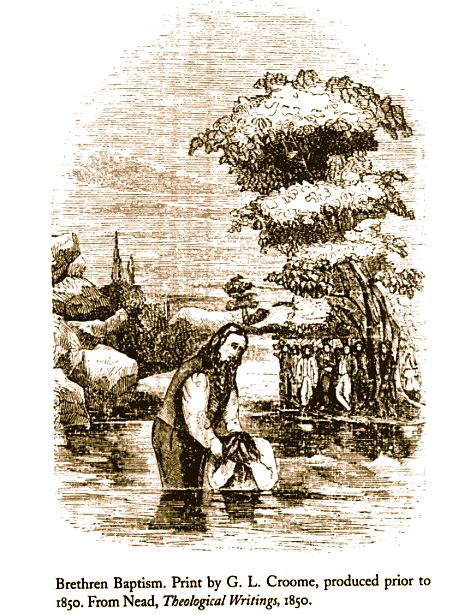
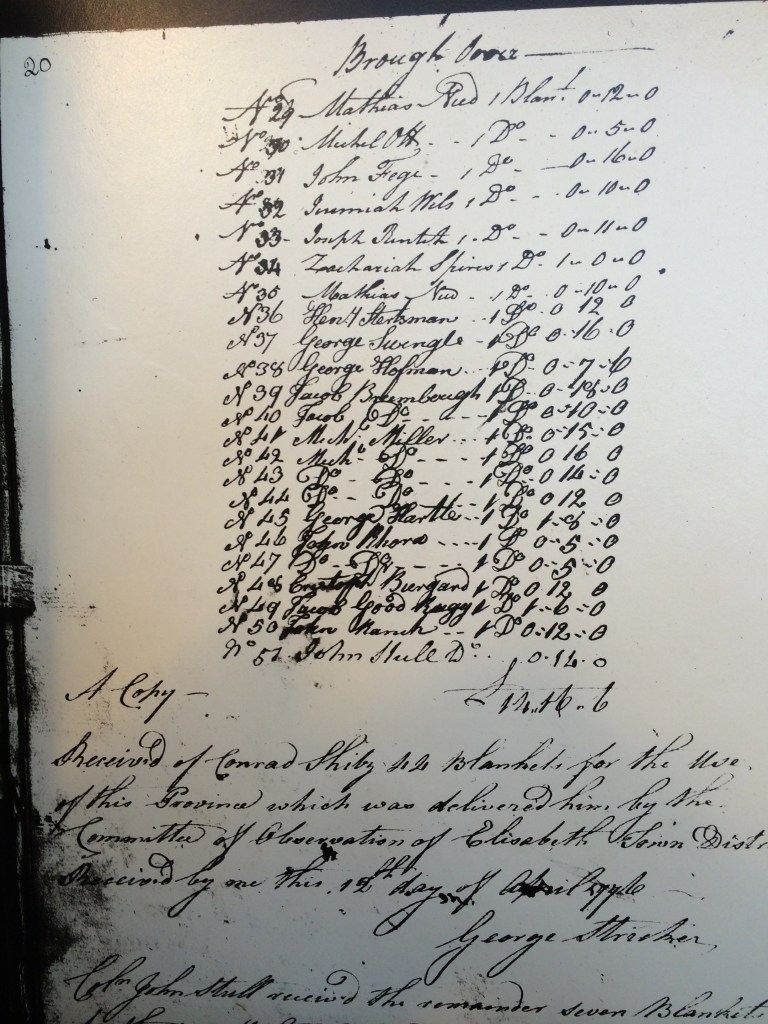
Jacob Brumbaugh sells his grains and blankets to the Militia– a patriotic act.
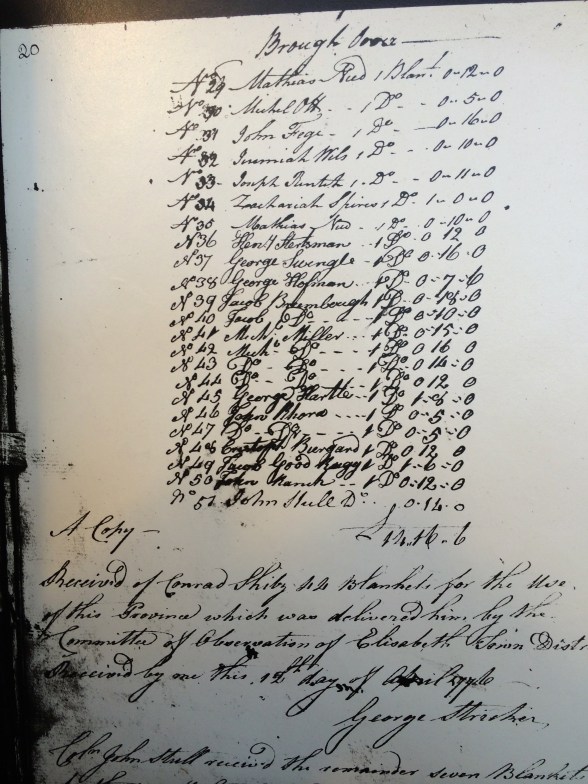
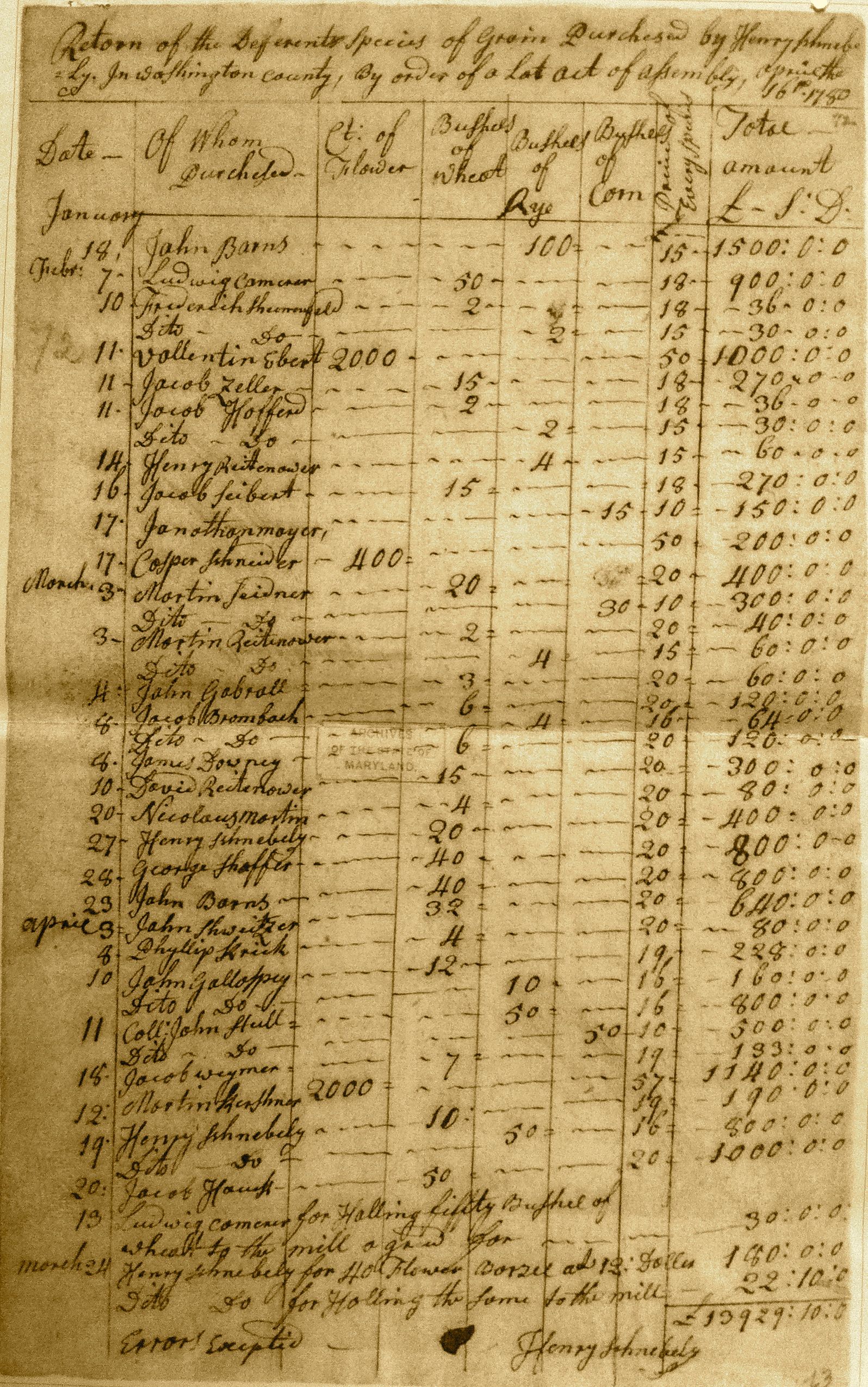
Original 1780 receipt by Dr. Henry Schnebely, purchasing agent for the Continental Army, buying wheat and rye grains from his neighbors, including sectarian non-jurors– those who, for religious reasons, refused to take the oath of allegiance to the new government– such as Jacob Brumback (aka Brumbaugh). See March 8 date, the name Jacob Bromback and the “ditto” line below it. Schnebely was Brumbaugh’s immediate neighbor and also a member of the Committee of Observation. The title of the receipt reads “Retorn of Deferent Species of Grain Purchased by Henry Schnebely in Washington County by order of a Act of Assembly April the 16th 1780.” The columns are labeled for Flower (flour), wheat, rye, and corn. The Hagerstown area was a main “breadbasket” of the colonies. Though Jacob might have been a conscientious objector, and a non-juror, having sold provisions to the Continental army, one hundred twenty years later later qualified Jacob as a “patriot” in the eyes of the Daughters and Sons of the American Revolution (DAR & SAR). An interesting paradox, don’t you think?
 PORTRAIT of a PACIFIST as a PATRIOT